Table of contents
As enterprises race to adopt AI agents, many are running into the same problem: automation that doesn’t scale reliably on its own.
You may have agents handling individual tasks across IT, HR, or operations, but without a shared foundation, those agents struggle to coordinate, adapt, or operate reliably across systems. The result is brittle workflows, manual handoffs, and growing governance risk.
This challenge is becoming more common as AI agent adoption accelerates. More than half of enterprises now use AI agents in some form, driven by demand for autonomy and faster decision-making. Yet many of these deployments remain fragmented: effective in isolation, but difficult to manage, secure, or extend across the organization.
Agentic frameworks address this gap. They provide the structure that allows autonomous AI agents to reason, communicate, and collaborate as part of a cohesive system, enabling intelligent, self-directed automation that can scale securely across the enterprise.
In this guide, you’ll learn:
- What an agentic framework is and how it differs from task-based automation
- Why agentic frameworks are essential for enterprise autonomy
- How to evaluate frameworks that can scale AI agents securely across your organization
What is an agentic framework?
An agentic framework provides the foundational structure for building autonomous AI systems that can reason, coordinate, and take action across enterprise environments.
Rather than focusing on individual models or isolated tasks, an agentic framework defines how multiple AI agents interact with each other and with enterprise systems to achieve shared objectives. It establishes the rules, protocols, and architectural patterns that govern autonomous behavior at scale.
At its core, an agentic framework defines how agents:
- Communicate and exchange context
- Coordinate actions across workflows
- Reason about goals, constraints, and policies
- Make decisions and adapt based on outcomes
This structure allows organizations to move beyond isolated automations and build multi-agent systems that operate cohesively across enterprise platforms, including IT service management platforms (ITSM), HR systems, identity providers, and collaboration tools.
For example, in an enterprise IT or HR environment, an agentic framework can enable multiple agents to collaborate on a single request, such as onboarding a new employee, by coordinating access provisioning, approvals, policy checks, and system setup across platforms. Each agent handles a specific responsibility, while the framework helps ensure the overall workflow can remain aligned, auditable, and secure.
By providing a consistent foundation for autonomy, agentic frameworks make it easier for enterprises to design, deploy, and scale intelligent agents that can operate reliably within complex, multi-system environments.
Key features of agentic frameworks
Agentic frameworks are designed to bring structure, consistency, and scalability to autonomous AI systems.
Rather than treating agents as isolated automations, these frameworks define how agents are built, coordinated, governed, and improved over time, enabling enterprises to deploy autonomy safely as a system, not a collection of scripts.
The following features distinguish enterprise-ready agentic frameworks from traditional AI models and task-based automation tools.
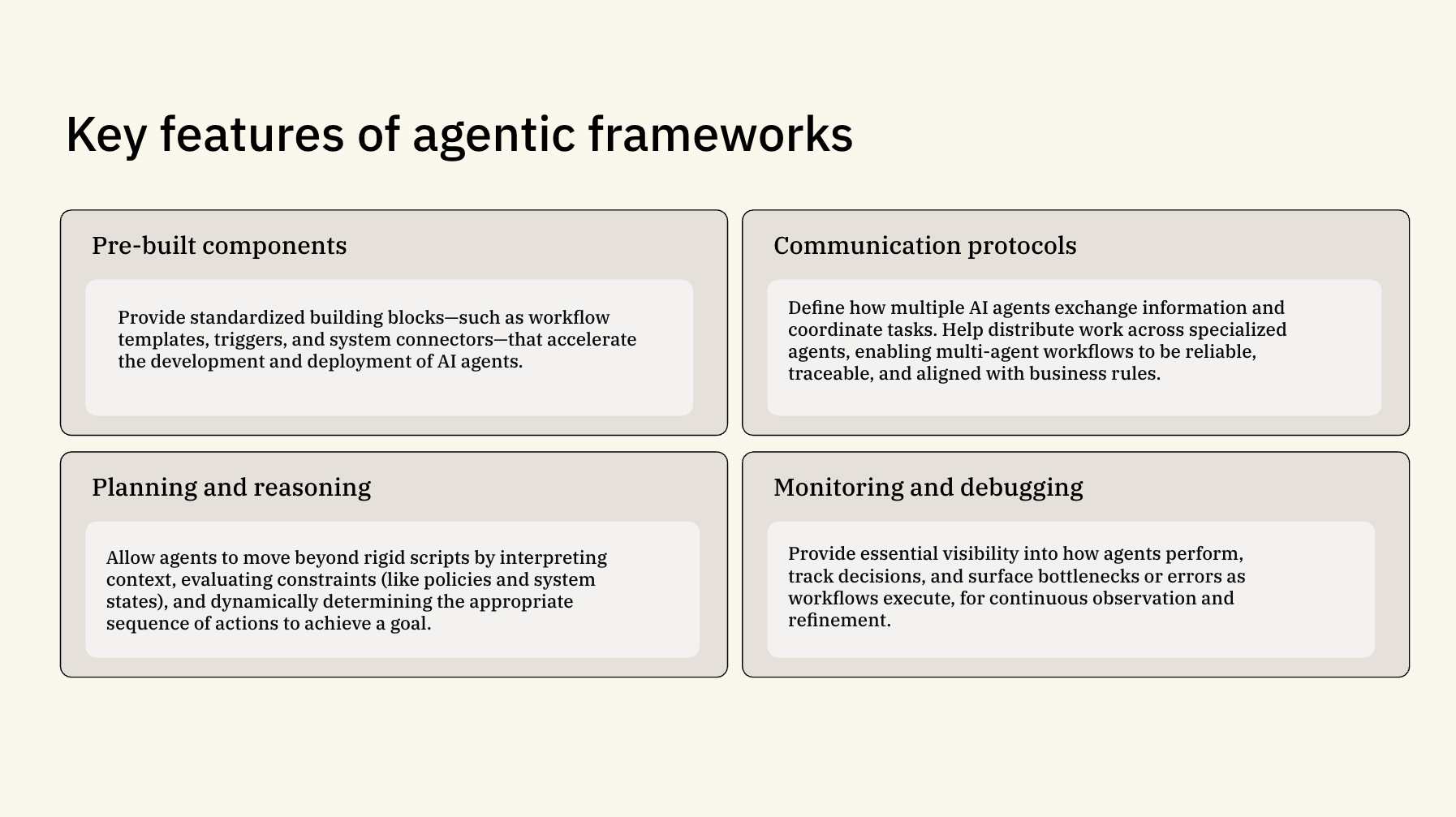
Pre-built components
Agentic frameworks typically include pre-built components that accelerate the development and deployment of AI agents while enforcing consistent agent behavior. These components provide standardized building blocks — such as workflow templates, triggers, actions, and system connectors — that reduce the need to design every agent from scratch.
In enterprise settings, pre-built components enable teams to deploy agents more quickly and consistently across systems like IT service management platforms, HR tools, and identity providers. Instead of reimplementing reasoning and execution logic for every use case, organizations can reuse validated patterns to ensure agents behave predictably and align with operational and security requirements.
By standardizing how agents reason, act, and integrate with systems, pre-built components help enterprises scale autonomy while maintaining reliability, consistency, and control.
Communication protocols
Communication protocols define how AI agents exchange information, coordinate tasks, and hand work off to one another within an agentic system. In an enterprise context, these protocols are critical for ensuring that multi-agent workflows remain reliable, traceable, and aligned with business rules.
Rather than relying on a single agent to perform every action, agentic frameworks use structured communication patterns to distribute work across specialized agents. Each agent focuses on a specific responsibility — such as validating inputs, executing actions, or enforcing policies — while the framework governs how information flows between them.
This approach helps reduce errors, improve accountability, and maintain workflow integrity as systems scale. For example, in an IT or HR workflow, one agent may handle identity verification while another provisions access or updates records. Communication protocols ensure these agents share the right context, follow the correct sequence, and surface exceptions when additional approvals or checks are required.
By standardizing agent communication, agentic frameworks make workflows more resilient. They help enterprises scale autonomous systems without losing visibility, control, or confidence in how work gets done.
Planning and reasoning
Planning and reasoning capabilities are what allow AI agents to move beyond scripted automation and operate autonomously within complex environments. Agentic frameworks incorporate reasoning engines that enable agents to interpret context, evaluate constraints, and determine the appropriate sequence of actions needed to achieve a goal.
Instead of following rigid, pre-programmed workflows, agents can assess variables such as user role, system state, policies, and historical outcomes. This allows them to plan dynamically, adjust when conditions change, and handle exceptions without requiring constant human input.
For example, in an enterprise IT or HR workflow, an agent may receive a request that initially appears routine but requires additional validation based on security policies or organizational rules. With planning and reasoning capabilities, agents can identify these conditions, route the request for approval if needed, and resume execution once requirements are met, without breaking the workflow.
By enabling agents to reason about outcomes — rather than execute isolated steps — agentic frameworks reduce manual intervention, improve consistency, and support more reliable automation at enterprise scale.
Monitoring and debugging
Monitoring and debugging capabilities are essential for maintaining trust and reliability in autonomous systems. Agentic frameworks typically include tools that allow teams to observe agent behavior, track decisions, and identify issues as workflows execute across enterprise environments.
These capabilities provide visibility into how agents perform over time, surfacing bottlenecks, errors, or unexpected outcomes before they become systemic problems. For example, if an automated workflow consistently slows down due to missing data or approval delays, monitoring tools can help teams pinpoint where the breakdown occurs and adjust the system accordingly.
Debugging tools also make it easier to evolve agentic systems safely. When changes are required such as updating policies, integrations, or decision logic, teams can test, trace, and refine agent behavior using real-time insights rather than trial-and-error fixes.
By enabling continuous observation and improvement, monitoring and debugging features help enterprises operate autonomous agents with confidence, ensuring automation remains reliable, compliant, and aligned with business objectives as it scales.
Why agentic frameworks are important
As enterprises expand their use of AI agents, the challenge shifts from experimentation to scale. Running a handful of agents in isolation may work initially, but without a shared framework, autonomy becomes difficult to manage, govern, and evolve.
Agentic frameworks provide the structure organizations need to operationalize autonomy safely and consistently across the enterprise.
By standardizing how agents are built, coordinated, and monitored, agentic frameworks help enterprises move beyond fragmented automation and toward system-level transformation without increasing operational risk or manual oversight.
They make it possible to deploy autonomous agents that operate reliably across teams, tools, and workflows, without introducing unnecessary risk or complexity.
At an enterprise level, agentic frameworks enable high-impact use cases such as:
- Automating IT provisioning and access management, reducing manual tickets and approval delays
- Streamlining HR onboarding and offboarding, coordinating tasks across systems and teams
- Improving employee support, by routing and resolving requests more efficiently
- Scaling operational workflows, without increasing headcount or manual oversight
By providing a consistent foundation for autonomy, agentic frameworks help enterprises unlock efficiency, resilience, and long-term scalability, turning AI agents into reliable contributors rather than isolated experiments.
Agentic AI frameworks
Agentic AI frameworks vary widely in how they support autonomy, orchestration, governance, and scale. Some are designed for rapid experimentation, while others emphasize reliability, state management, and long-running workflows.
Here are several commonly used agentic frameworks and how they are typically applied today.
Agentic AI frameworks at a glance
Framework | Primary strength | Best for | Enterprise suitability |
LangGraph | Stateful orchestration & reliability | Long-running, governed workflows | High |
CrewAI | Team-based agent collaboration | Coordinated multi-agent tasks | Medium |
OpenAI Agents SDK | Production-ready agent orchestration | OpenAI-based agent workflows | Medium to high |
LLaMA | Open-weight reasoning models | Flexible model deployment | Depends on orchestration |
AutoGen | Delegated agent reasoning | Complex agent interactions | Medium |
JADE | Distributed agent communication | Java-based systems | Medium to high |
ARCADE | Reactive agent logic | Simulations & robotics | Low to medium |
1. LangGraph
LangGraph is a graph-based framework for building stateful, multi-agent workflows, especially important for long-running or approval-based workflows common in IT and HR. It gives teams explicit control over execution paths, branching logic, and state, making it well suited for complex workflows that must run reliably across enterprise systems.
A key strength of LangGraph is its support for durable execution (i.e. workflows that can pause and resume without losing progress). and state persistence.
Agents can pause, resume, and recover from interruptions while maintaining context — capabilities that are especially important for long-running or approval-based workflows.
Built-in human-in-the-loop patterns that offer built-in moments for human review or approval also allow teams to introduce checkpoints for review, exception handling, or policy enforcement.
LangGraph is commonly used when enterprises need predictable orchestration, strong observability, and the ability to coordinate multi-step processes without sacrificing control.
2. CrewAI
CrewAI is an agent orchestration framework built around the concept of “crews,” groups of specialized agents that collaborate to complete complex tasks. Each agent is assigned a distinct role, allowing work to be divided and coordinated in a structured way.
The framework emphasizes clear task delegation and multi-agent collaboration, making it effective for workflows role-based agent collaboration, where responsibilities can be cleanly separated. CrewAI also supports structured execution flows that help teams organize how agents interact across multi-step processes.
CrewAI is often chosen by teams that want a straightforward mental model for coordinating multiple agents and are comfortable operating within a fast-evolving ecosystem.
3. LLaMA (model ecosystem, not a framework)
LLaMA is a family of open-weight large language models developed by Meta. While LLaMA itself is not an agentic framework, it is frequently used as the reasoning layer within agentic systems.
Organizations typically pair LLaMA models with orchestration frameworks to enable capabilities such as tool use, multi-step planning, and contextual decision-making. The availability of multiple model sizes allows teams to balance performance, cost, and deployment flexibility across environments.
LLaMA is best viewed as a foundational model ecosystem that supports agentic behavior when combined with frameworks that handle orchestration, governance, and execution.
Other common agentic AI frameworks
Agentic frameworks continue to evolve rapidly. Here are additional approaches enterprises may encounter, each with different design priorities and use cases.
4. OpenAI Agents SDK
The OpenAI Agents SDK provides a production-ready approach for building agentic systems using OpenAI models. It offers structured primitives for defining agents, coordinating handoffs between them, and managing execution across multi-step workflows.
Designed for real-world deployment, the SDK includes capabilities such as session management, guardrails, and tracing. These features help teams observe agent behavior, enforce constraints, and debug workflows as they scale, making the SDK better suited for enterprise environments than earlier experimental approaches to multi-agent coordination.
The OpenAI Agents SDK is typically evaluated by teams looking to build agentic workflows closely integrated with OpenAI’s model ecosystem, while maintaining visibility and operational control.
5. AutoGen
AutoGen is a framework focused on structuring multi-agent interactions and delegated reasoning that splits decisions across multiple AI agents. It provides built-in patterns for agent communication, task decomposition, and coordination across complex workflows.
AutoGen is often paired with additional tooling for monitoring, governance, and deployment when used in production environments. It is well suited for scenarios that require modular agent orchestration and collaborative reasoning across multiple agents.
6. Java Agent Development Framework (JADE)
JADE is a Java-based framework that implements FIPA standards for distributed agent communication. It offers a mature ecosystem, asynchronous message-passing, and strong support for message-driven architectures.
JADE is commonly used in environments that already rely heavily on Java and distributed systems. However, it is less focused on large-language-model-driven reasoning and modern agent orchestration patterns.
7. Foundation for Intelligent Physical Agents (FIPA)
FIPA is a standards organization that defines interoperability and communication conventions for multi-agent systems, including Agent Communication Language (ACL) and Agent Management System (AMS).
While FIPA does not provide a runtime framework, its specifications continue to influence how traditional agent systems communicate and interoperate, particularly in legacy or research-oriented environments.
8. ARCADE
ARCADE is a reactive agent framework designed for environments where agents must respond dynamically to changing conditions, such as simulations or robotics.
Its strengths lie in real-time reaction and environmental responsiveness, making it more applicable to embedded or simulation-based systems than to typical enterprise IT or HR workflows.
Other emerging agentic frameworks
Ray RLlib
Ray RLlib is a distributed reinforcement learning library used for large-scale, multi-agent training and simulation.
It is primarily applied in research and experimental environments rather than enterprise-focused, LLM-driven agent orchestration.
MAgent
Multi-agent (MAgent) Platform is a research-focused platform for many-agent reinforcement learning, designed to support large-scale simulations involving hundreds or millions of agents.
It is primarily used in academic and experimental environments rather than enterprise agent orchestration.
Ecosystem stacks such as LLaMA Stack
Comprehensive model inference and tooling layers that can be paired with agentic orchestration frameworks to support production-grade autonomous systems.
Llama Stack provides modular components for inference, RAG, safety, and agentic APIs that developers can integrate with external orchestrators and frameworks.
How to choose an agentic framework
The right agentic framework should support autonomy at scale while fitting into your existing enterprise environment, governance model, and long-term automation strategy.
When evaluating options, enterprises should focus on the following criteria:
1. Governance and security
As agents gain the ability to act autonomously, governance becomes critical. Look for frameworks that support clear boundaries around what agents can access, decide, and execute.
Enterprise-ready frameworks should make it possible to:
- Enforce role-based access and permissions
- Audit agent decisions and actions
- Introduce approval checkpoints for sensitive workflows
- Maintain compliance with internal policies and regulatory requirements
Without built-in governance mechanisms, autonomous systems can quickly introduce risk as they scale.
2. Integration and ecosystem fit
Agentic frameworks must operate within an existing ecosystem of enterprise tools and data. Before selecting a framework, evaluate how easily it integrates with systems such as IT service management platforms, HR systems, identity providers, and collaboration tools.
Key questions to consider include:
- Does the framework support APIs and extensibility for your core systems?
- Can agents exchange context and data across tools without custom glue code?
- How well does the framework fit with your existing cloud, data, and security architecture?
Strong integration capabilities reduce friction and make agentic systems easier to maintain over time.
3. Reasoning and orchestration capabilities
Not all frameworks offer the same level of reasoning and coordination. Some focus on simple task execution, while others enable agents to plan, adapt, and collaborate across multi-step workflows.
Enterprises should look for frameworks that support:
- Context-aware decision-making
- Dynamic planning and exception handling
- Coordination across multiple agents and systems
These capabilities are essential for moving beyond scripted automation toward more autonomous, outcome-driven workflows.
4. Scalability and operational reliability
Early agent deployments may involve a small number of workflows, but successful initiatives tend to grow quickly across regions, teams, and functions. A framework should be able to scale without requiring teams to redesign core logic or compromise reliability, including support for global deployment and multi-team ownership.
Consider whether the framework supports:
- Long-running and stateful workflows that remember past steps and context
- Fault tolerance and recovery
- Monitoring, logging, and observability as deployments expand
Frameworks designed for experimentation may struggle under enterprise-scale demands.
5. Team skills and operating model
Finally, consider who will be responsible for building, maintaining, and evolving agentic systems. Some frameworks require deep engineering expertise, while others are more accessible to cross-functional teams.
Align the framework with:
- Your team’s technical skills
- Your preferred development and deployment workflows
- How quickly you need to move from pilot to production
The right choice balances flexibility with usability, enabling teams to innovate without creating long-term operational debt.
Agentic framework vs AI agent builder: What’s the difference?
Agentic frameworks and AI agent builders are closely related, but they serve different purposes. Understanding the distinction is critical when deciding how to design, deploy, and scale autonomous agents across the enterprise.
At a high level:
- Agentic frameworks provide the foundational architecture for building autonomous, multi-agent systems.
- AI agent builders provide higher-level tools that make it easier to design, configure, and deploy agents on top of that foundation.
Most enterprise-grade agent implementations rely on both but at different layers of the stack.
Key differences at a glance
Dimension | Agentic frameworks | AI agent builders |
Primary purpose | Define how agents reason, coordinate, and act | Simplify how agents are created and deployed |
Level of abstraction | Low to medium (architectural) | Medium to high (user-facing) |
Technical skill required | Engineering and systems design expertise | Ranges from low-code to developer-friendly |
Core focus | Orchestration, reasoning, governance, scalability | Configuration, workflows, usability |
Governance and control | Built into the framework architecture | Often exposed as configurable controls |
Scalability | Designed to support enterprise-scale autonomy | Depends on the underlying framework |
Best suited for | Designing complex, multi-agent systems | Rapid agent development and iteration |
Agentic frameworks: Build the foundation for complex AI systems
Agentic frameworks define the underlying structure that enables autonomous behavior at scale. They govern how agents communicate, plan actions, handle exceptions, and interact with enterprise systems over time.
Enterprises typically rely on agentic frameworks when they need:
- Multi-agent coordination across systems and teams
- Context-aware reasoning and dynamic planning
- Governance, auditability, and long-running workflows
- A consistent architectural foundation for scaling autonomy
These frameworks are essential when autonomy must be reliable, explainable, and controlled, rather than experimental.
AI agent builders: Create and deploy agents more easily
AI agent builders sit higher in the stack, translating framework-level capabilities into tools that are easier for teams to use. They often provide visual interfaces, templates, and pre-built integrations that reduce the effort required to design and deploy agents.
Agent builders are commonly used when:
- Teams want to move quickly from idea to deployment
- Non-specialists need to configure or manage agents
- Standard use cases can be implemented with minimal custom logic
Examples of agent builders include platforms such as Microsoft Bot Framework and Google Dialogflow, which abstract orchestration complexity while relying on underlying frameworks.
How to think about frameworks vs agent builders
Agentic frameworks and agent builders are not competing choices. They’re complementary. The framework provides the structural backbone for autonomy, while the builder provides the interface and tooling that makes that autonomy accessible.
For enterprises, the key decision is not which one to choose, but how they work together to support governed, scalable, and sustainable AI agent deployments across teams and regions.
How Moveworks operationalizes the agentic framework for the enterprise
Agentic frameworks define how autonomous agents reason, coordinate, and act. But turning those ideas into systems that work reliably at enterprise scale requires more than architecture alone.
Moveworks is built on an agentic framework designed for enterprise environments, helping you translate core agentic concepts such as orchestration, reasoning, and observability into automation you can deploy, govern, and scale with confidence.
Instead of treating agents as isolated tools, Moveworks enables you to run them as part of a coordinated system across IT, HR, and employee-facing workflows.
- Moveworks Agent Studio is designed to help you operationalize agentic frameworks, giving your teams a structured environment to build AI agents.
- AI agent marketplace lets you choose and quickly deploy hundreds of pre-built agents for Workday, SAP, Servicenow, Salesforce, and many more.
Together, this approach helps you move faster quickly to production ready. You can deploy agents that don’t just automate tasks, but operate as part of a coordinated, governed system, supporting long-term autonomy, reliability, and scale.
Ready to build and deploy enterprise-ready AI agents?
Explore how Moveworks Agent Studio helps you turn agentic frameworks into real-world automation.